 | The Xenophile Historian |

 |
 |
 |
 |
 |
 |
 |
A History of Russia
Chapter 2: KIEVAN RUSSIA
862 to 1300
This chapter covers the following topics:
 |
The Kievan Principality |
|
A Christian Russia |
|
The Decline of Kiev |
|
The Mongol Conquest |
|
The Baltic Crusades Begin |
|
Alexander Nevsky |
|
The Golden Horde |
|
Go to Page Navigator |
The Kievan Principality
In the last section of Chapter 1, we looked at how the Slavs expanded and settled most of eastern Europe, and in the process of spreading out, how they divided into Eastern, Western, and Southern Slavs. We also saw the Varangians, Vikings from Sweden, explore Russia's waterways, and because the Eastern Slavs had no organization above the tribal level, the Varangians conquered them easily in the 850s.
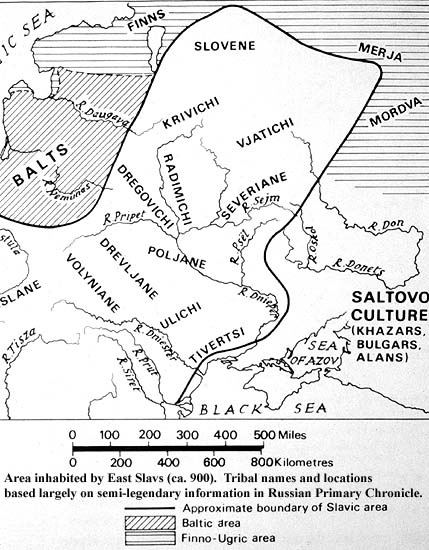
What happened next is uncertain because the only detailed source of information we have on Kievan Russia is a history book called The Primary Chronicle. Unfortunately the first edition of this work was written in 1037, long after most of the interesting events it describes had happened, so its accuracy is questionable. If this account can be trusted, sometime around the middle of the ninth century (855?) the Slavs living in the village of Novgorod revolted and threw out the Varangians, only to find that they could not govern themselves effectively. A group of Varangians, led by a prince named Rurik, was invited back, not as colonizers but as leaders and defenders of an independent Slavic state. Novgorod became Russia's first capital. The infant state was called Rus, which later became "Russia."(1)
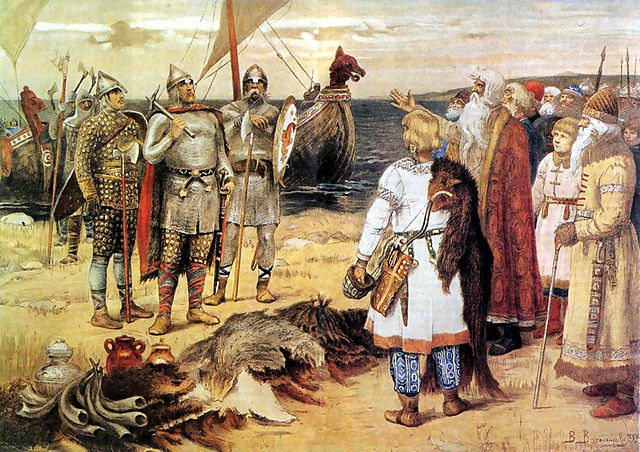
Rurik had a son named Igor, but he was still very young when Rurik was on his deathbed, so Rurik appointed a kinsman, Oleg, to manage the new state. However, instead of stepping down when Igor grew up, Oleg held the throne for life (878-912), and then the throne passed to Igor. Oleg began his reign by bringing the other Varangian-ruled city-states in Russia under his authority. Then he chose a new capital, concluding that since Byzantine gold was what the Vikings wanted most, the best place for a capital would be on a river and as close to the Black Sea as possible. That turned out to be on the banks of the Dnieper, right where the forests ended and the Ukrainian steppe began; Oleg conquered the Slavic village there, Kiev, and it grew to become a splendid city. The Greeks, however, were uncooperative about trading with these newcomers, so Oleg sent an expedition to Constantinople to change their minds, consisting of 2,000 ships carrying 80,000 Vikings. When they got there they found most of the Byzantine forces out of town, fighting Arabs, Bulgars and Petchenegs elsewhere, but a big chain was drawn across the harbor to keep hostile ships out. Undaunted, Oleg beached his ships a few miles away, let his troops pillage the surrounding countryside for whatever they could kill and loot, and when they were done with that, he ordered them to make wheels and mount them on the boats. Then he waited for a good tailwind; some boats could be pushed overland by the wind alone, and for the rest, Oleg got the men and horses to give the wind a hand. The sight of such a huge fleet rolling up to the walls of Constantinople terrified the Greeks and they sued for peace; Oleg went home with a nice trade agreement and a ransom of six pounds of silver paid to each of his men. Byzantine-Russian relations were quite good after that, bringing prosperity to both countries.
A curious tale exists concerning Oleg's death. It seems that one day a sorcerer came to the prince and warned that his favorite steed would cause his death. Oleg never rode that horse again and did not even go near it, but he made sure it was well cared for. Years later, Oleg asked how his horse was doing, and was told that the horse had died in a pasture. Apparently the sorcerer was still around, because Oleg told him his prediction had been wrong, then went to see the place where the horse's bones lay. Upon arriving he laughed and remarked, "So I was supposed to receive my death from this skull?" But when he stamped upon the skull a poisonous snake crawled out and fatally bit him on the foot.
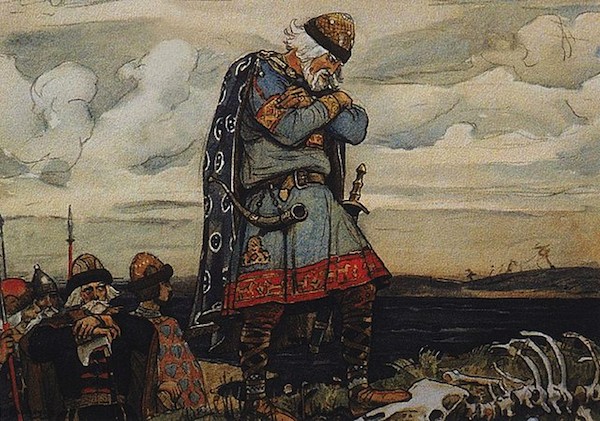
Oleg tramples the bones of the horse.
Now Igor, the son of Rurik, finally got his chance to rule. He wasn't as successful as Rurik and Oleg had been. For example, twice he launched a raid on Constantinople, in 941 and 944, and though he did get a favorable treaty from the Byzantines, he also lost several ships to the Byzantine secret weapon, a flamethrower called "Greek fire" (see this footnote). What caused his ultimate failure was his lack of money after the raids (wars are expensive, after all), and the tax-gathering missions he sent among the Slavic tribes to get more money.(2) One of those tribes was the Drevlians; they had paid taxes to Oleg, but that didn't make them feel they owed anything to Igor, and now they resented Igor raising his taxes on them more than once. Igor personally led the warriors who went to collect taxes from the Drevlians; in the battle that followed, Igor was knocked unconscious, and the Drevlians captured him. When Igor woke up, he found that the Drevlians had pulled down the tops of two young birch trees until they touched the ground, and tied one of his legs to each tree. Then they released the trees, and the trees snapped back to their original position, tearing Igor in two! Igor's widow Olga took over as regent, until their son Svyatoslav came of age. Overall she ran the country well, but when dealing with the killers of her husband she didn't know when to quit!
The first act of revenge came when a delegation of twenty Drevlians came with a marriage proposal from their prince. They must have figured she would accept because in the Middle Ages, an unmarried woman was in a dangerous situation, and if she accepted, they would take over the whole Russian state by default. Instead, she had them buried alive. Next, she sent word to the Drevlian prince that she had accepted the offer, but he would have to send all of his best men to the wedding to make her people accept it. The prince sent the tribe's elite, and when they arrived, she directed them to a bathhouse where they could get cleaned up after their long journey. Once her guests were in there, she had the doors locked and the bathhouse set on fire, burning them to death. Before word could get back to the Drevlians about the deaths of their best and brightest, she invited more of them to come and attend a feast over her husband's grave. The ones who came drank in Igor's memory until they were drunk well beyond the legal limit; at that point Olga's soldiers attacked and killed 5,000 of them. And that wasn't all; Olga sent the Kievan army to the Drevlian capital. When they got there the Drevlians begged for mercy, and all Olga asked in return was three pigeons and three sparrows from each house. The besieged folks gave the birds gladly, figuring they had gotten off easy. That night, Olga ordered the soldiers to tie pieces of sulfur to the birds with thread, and release them. The pigeons and sparrows all flew back to their nesting places, and set the entire city on fire. Those who fled from the city were killed, enslaved, or forced to pay tribute.
Sometime after that episode, Olga went to Constantinople to be baptised, becoming the first Russian ruler to accept Christianity. However, she didn't do very much to spread the new faith; she failed to convert her son Svyatoslav, for instance, leaving the job of converting the whole country to her grandson Vladimir I (see below). Still, the Orthodox Church made her a saint, and even gave her the title "Equal to the Apostles." Maybe the clergy just figured they had better stay on the good side of the Grand Princess.
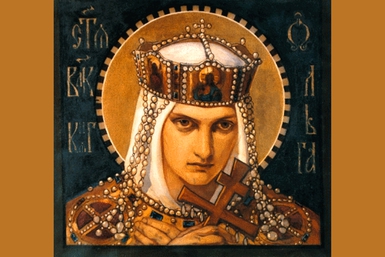
Princess Olga. This is a woman you don't want to mess with!
By the time Svyatoslav (962-972) took the throne, the Varangians had been completely assimilated into their Slavic subjects; the last syllable in his name tells the story. Like your typical Viking, he has been described as a formidable warrior with blonde hair and blue eyes, but he also wore a big mustache and cut his hair in a sidelock, which were Slavic/Turkic fashions. Svyatoslav believed that the best defense is a good offense; in a series of campaigns he wrecked the Khazar kingdom (965) and conquered both the Volga (966) and Danube (970) Bulgars, enlarging the size of the country tremendously. He went too far, however, when he decided to make Pereyaslavets, a city on the Danube, his new capital. For the Byzantine Empire that was just too close, and the Byzantines combined their forces with the Danube Bulgars to inflict a sharp defeat. Svyatoslav fled back to Kiev, but before he got there he was ambushed by a Petcheneg raiding party. Most of his conquests were lost with his death.
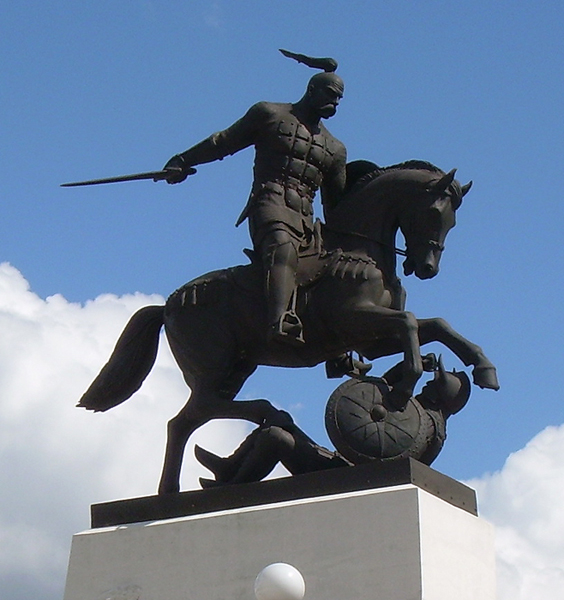
In 2005, the Russian sculptor Vyacheslav Klykov erected this controversial statue in a Ukrainian village, showing Svyatoslav trampling a Khazar warrior. Because the Khazars were Jewish (see Chapter 1), and a Star of David is visible on the statue, many have called this work an act of anti-Semitism. From Wikimedia Commons.

A Christian Russia
Svyatoslav's three sons fought a bloody eight-year civil war for their late father's crown, which ended in 980 when Vladimir I was the only son left. The Primary Chronicle describes the young Vladimir as a cruel and lecherous man who had seven wives and eight hundred concubines. He was a competent administrator and military commander, but the outstanding event of his reign is the conversion of Russia to Christianity in 988. Prior to that, the Slavs had been pagans who worshiped many gods, often with human sacrifices. Each community had its own god, represented by faces carved into logs like Indian totem poles. In addition there were a number of gods worshiped by all Slavs, and each had a specific portfolio in the Slavic pantheon; among them were Svarog (god of fire), Dazhbog (wealth), Khors (the sun), Perun (thunder), and Volos (poetry and commerce). Vladimir himself had been an enthusiastic supporter of paganism originally, erecting new idols wherever he went. But after a few years he noticed how far Russia was, both technologically and culturally, behind the civilized nations of his time; indeed, everybody regarded the Russians as just another barbarian tribe. A modern religion would bring in literacy and culture from those places where it already existed, and it would encourage political unity in a country where it was practically nonexistent, except wherever the Grand Prince happened to be.
Once Vladimir made that fateful step, he had to decide which religion was for him. Jews, Moslems and Christians were all willing to have Vladimir as a convert; the first to try it were the Khazars, who sent a delegation to teach him Judaism. When Vladimir asked why the Jews did not live in their native land, they answered, "God was angry at our forefathers and scattered us on account of our sins. Our land was given to the Christians." Vladimir, who could see no hope in a faith that exiles its own people, dismissed the Khazars.
The Volga Bulgars sent a delegation preaching the attractions of Islam, and they played right into Vladimir's natural desires when they promised that, "In the next world, Mohammed will give each man 70 fair women." But all prospects for a Moslem Russia disappeared when Vladimir learned that Moslems do not drink alcohol; he dismissed them by saying, "Drinking is the joy of the Rus. We cannot exist without that pleasure."(3) The Germans who came from the pope got the same treatment when they explained that fasting is an important part of Catholicism; Vladimir told them, "Depart hence; our fathers accepted no such principle."
The only case that impressed the Grand Prince came from the single Greek theologian who represented the Orthodox Church. He summarized both the Old and New Testaments and then held up an icon showing the Last Judgment, with the saints and sinners being separated for Heaven and Hell. If the Grand Prince wished to be with the righteous, urged the theologian, then he must be baptized. Still not entirely convinced, Vladimir sent a group of ten "good and wise men" to view the rites of each of the four religions close up. Most of the worship they saw was without glory until they came to the cathedral of Hagia Sophia in Constantinople. Overwhelmed by the incense, singing, pageantry, etc., they came back reporting that "We knew not whether we were in Heaven or on earth." Thus Russia came into the Orthodox faith.
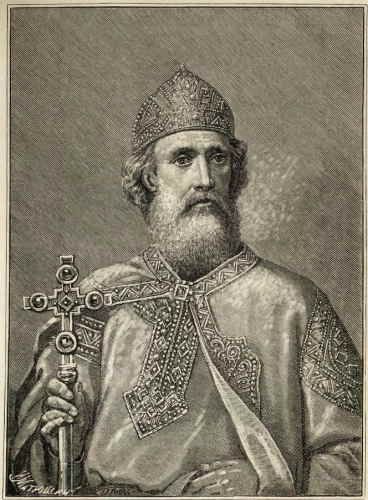
Vladimir I.
Undoubtedly there were other reasons for Vladimir's conversion to go along with the spiritual one described above. He had his own grandmother's conversion as an example, to start with. Like the Khazars, he probably did not want to become a Catholic or a Moslem because that would have put him under the domination of the pope or the caliph. Also, the Byzantine Empire respected the strength and courage of the Varangians, and around this time the emperor, Basil II, requested Russian soldiers to help him in his wars. Vladimir responded by asking for Basil's sister, and because the Byzantines did not want to give an imperial princess in marriage to a pagan, they said they would only do it if Vladimir was baptized. Vladimir accepted baptism, but then had to attack and take the Byzantine city of Kherson in the Crimea, when Basil tried to back out of the promise. After the marriage Byzantium and Russia treated each other as equals.
Vladimir became a fervent evangelist of the new faith for the rest of his life, tearing down the idols he had erected before. Unfortunately, after his death in 1015 the country was plunged into another bloody fratricidal war for the throne on account of Vladimir's pre-Christian lifestyle; he left behind twelve sons from different mothers who cared little for each other. The eldest, Svyatopolk, killed three brothers, Svyatoslav, Boris, and Gleb, to make his claim to the throne stick.(4) Two more brothers, Yaroslav and Mstislav, teamed up, rebelled, and finally killed Svyatopolk in 1024. The two victors ruled the kingdom jointly until 1036, when Mstislav died and left the whole realm to Yaroslav.
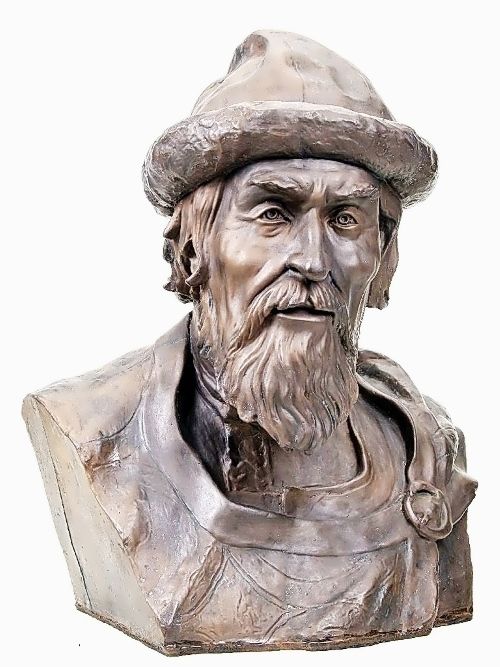
Yaroslav the Wise.
The eighteen years in which Yaroslav ruled alone (1036-54) are regarded as the peak of Kievan Russian civilization. Yaroslav promoted peace by marrying a Swedish princess, giving two sisters to the monarchs of Poland and Byzantium, and marrying three daughters to the kings of Norway, Hungary, and France. The Cyrillic alphabet was introduced from Bulgaria, and within a few years the Kievan literacy rate had risen to a higher level than most of Medieval Europe; Yaroslav's daughter Anna was able to sign her name to the marriage contract in Cyrillic as Anna Regina (Anna the Queen), while her bridegroom, Henry I of France, could only make an "X". Every manner of artisan was brought to Kiev, adding beautiful new buildings while Kiev grew into an impressive city of 80,000 people, as big as Paris was at that time. Whereas Vladimir I had been content to build a single church in Kiev, Yaroslav built churches all over the country, including the first Russian cathedrals in Kiev and Novgorod.
Most important of all, Yaroslav wrote down Russia's first law code. It is here more than anywhere else that one can see the differences between the Kievan state and more recent Russian governments. The law code of Yaroslav was the most enlightened and humane of medieval times; there was no death penalty, and all but the most serious crimes were punished by fines (a reflection of early Russia's preoccupation with commerce). Government was formally described as a mixture of three kinds: autocracy, aristocracy, and democracy. The Grand Prince's power was limited to handling justice and defense; in all other affairs he could be vetoed by the Duma, an advisory councils of boyars, or hereditary nobles. All other free men had a voice of their own in the Veche, an assembly that met in every town to handle local affairs. All of the Veche's decisions, however, required a unanimous vote to pass, leading to violent meetings that often got nothing done.
The Decline of Kiev
Yaroslav is often called "Yaroslav the Wise" for all of his achievements, but the way he bequeathed the kingdom was anything but that. Yaroslav divided the realm into five pieces, one for each son, giving Kiev to the eldest, Novgorod to the second, and so on. When one of the princes died each one younger than him was expected to move up a notch; e.g., if the second son died, the third was expected to give up Chernigov to take Novgorod. Yaroslav must have expected his sons to die in the order of their birth, until the youngest was left with the whole kingdom. It did not work that way; not only did the princes refuse to die in order, but while they were always willing to receive a piece of land, they were not willing to give up something which could be passed on to their children. Furthermore, the prolific Varangian dynasty always had more children than their were titles to give them. Soon every prince wanted to be Grand Prince of it all, and when they resorted to the sword, the result was a civil war that left Russia congested with city-states for the next 400 years.
About the same time (1060), a new Turkish tribe called the Polovtsy(5) migrated into the Ukraine. They proved to be more savage than their Petcheneg predecessors; e.g., in 1096 they got through Kiev's defenses and sacked the city. With the steppes no longer safe under any circumstances, trade with Byzantium dwindled to a trickle, and stopped completely when Constantinople was captured by the Fourth Crusade (1204). Kiev could not prosper without commerce, and many Russians moved away; some went to Galicia, in the foothills of the Carpathian mts., but most went northeast to found new cities along the upper reaches of the Volga and its tributary, the Oka. Here in these cold forests, commerce was not feasible (no customers nearby), the soil was poor and it was difficult to clear off farmland. A different society developed here, one that would someday come to dominate all of Russia.
The only prince after Yaroslav that ruled a united Russian state was his grandson Vladimir Monomakh (1113-25), a former prince of Smolensk. He was the first to encourage settlement of the northeast. His son Yuri Dolgorukii (1125-57) saw Russia's future in the northeast and made low-interest loans to attract more settlers. Many new cities were founded during his reign, including Moscow (1147).
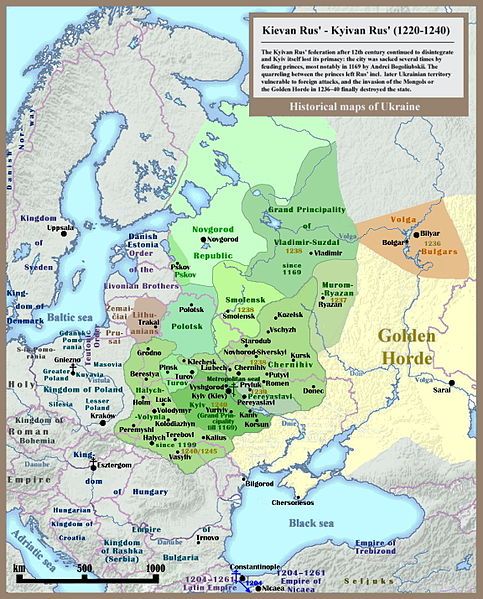
Yuri's son, Andrew Bogolubsky (1157-75), made some important changes in the government. He refused to become Grand Prince of Kiev, but instead built a new capital city, Vladimir, in the northeastern city-state of Rostov, with impressive walls and a cathedral to rival that of Kiev. Unlike the princes before him, he refused to respect the ruler of Kiev as "first among equals"; on the contrary, he attacked and looted Kiev in 1169 to show who was boss now. The Chronicle calls this the worst disaster to have befallen the Russian lands; not even the Polovtsy caused that much damage! Relations between the city-states broke down completely after that, and lawlessness became the rule.
At home Andrew eliminated the old system of checks and balances by intimidating the boyars and forbidding the Veche to meet in Vladimir; the Veche still held meetings in the former capitals--either Rostov or Suzdal--but now Andrew had taken away most of the power of his rivals by default. As Vladimir grew to become Russia's dominant city in the late 12th-early 13th centuries, the absolute monarchy that governed it became the model for Russia's tyrants in future ages.
The Mongol Conquest
In 1206 the tribes of Mongolia united under Genghis Khan to form the most formidable military force of the Middle Ages. This went unheralded in the rest of the world, but it would soon have catastrophic effects all over Eurasia. The first victim was northern China, followed by an invasion of Central Asia. By 1221 the Mongols had reached the Caspian Sea, and a scouting party of 15,000 was detached from the main army, to explore the lands farther west. They would make a complete loop around the Caspian Sea before they were done.
First they ravaged northern Iran, sacking the cities of Rai, Qom and Hamadan, but sparing Tabriz because it paid tribute. Next they entered the Caucasus and defeated the Georgians; when they heard the news, the Polovtsy tried to form a coalition with tribes like the Alans and Circassians to meet the new threat. The Mongols responded with treachery; they sent a message to the Polovtsy, inviting them to switch sides, because the Mongols were steppe nomads just like them, and gave them part of the loot they had gathered so far. Once the coalition was divided, the Mongols defeated its members separately, and then they hunted down the Polovtsy, cut them to pieces, and recovered their loot. In desperation the Polovtsy called on the Russians for help, but the 80,000-man Russian army was beaten near the Sea of Azov, in the battle of the Kalka (1223). After that victory the Mongols forced the leaders of their captives to lie down while they built a large wooden platform over them. The Mongols then held a feast on the platform, crushing the Russians to death.
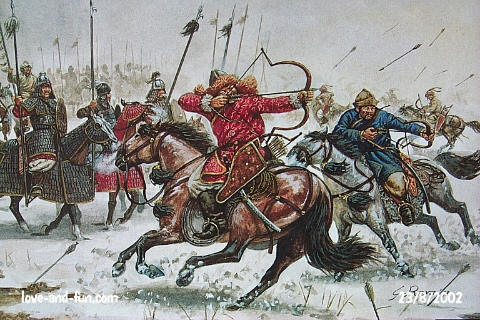
Now that they were done with the Russians, the Mongols ravaged the Ukraine and explored up the Volga, until they encountered stiff resistance from the Bulgars; then they suddenly left, making a beeline east across the steppes. They would not follow up on this expedition for more than a decade, because Genghis Khan needed those troops to conquer a tribe closer to home, the Tanguts in northwest China. As soon as that campaign was finished, Genghis Khan died (1227), and the Mongols took a lengthy time out to organize the empire he left behind.
When a Mongol chief divided his landholdings between his children, it was customary to give the piece farthest away from home to the eldest son; that encouraged another generation of conquering. But Juchi, the eldest son, had died six months before Genghis did, so Juchi's inheritance--the part of Russia conquered so far--went to two of Juchi's fourteen sons. The eldest son of Juchi, Orda, got the part of the steppes between the Irtysh River and the Urals (western Siberia & part of Kazakhstan); that would be called the realm of the White Horde. Another son, Batu, got the European portion of the steppes, which was called the Blue Horde at first. The fifth son of Juchi, Shiban, was a minor at this time, so he did not receive any lands, but later his descendants, the so-called Grey Horde or Shaybanids, would be put in charge of western Siberia, leaving just Kazakhstan for Orda's descendants. Although Batu was not the eldest, his brothers regarded him as the supreme leader of all these domains, which amounted to the northwestern quarter of the Mongol Empire. The official name for this area was the Kipchak Khanate (Kipchak was the Mongolian name for the Polovtsy, who made up the largest part of the local population), but Westerners knew it better as the Golden Horde, naming it after the color of Batu's tent, so that is the name we will use most of the time.
Back in Mongolia, the third son of Genghis, Ogotai (also spelled Ugedey), was elected as the new Great Khan. At first Ogotai continued what Genghis had started, conquering Iran, Korea, and more of China. Finally in 1236 he authorized a new expedition to advance as far west as possible, and it began to move at the end of the year, led by Batu Khan and Subotai, the aged but able general who had commanded the first expedition. Besides loot and adventure, the goal was to secure the inheritance of Batu, since the Mongols did not yet have firm control over any land west of the Volga. This time they brought 150,000 troops (2/3 of them Turkish) and siege equipment that they had learned to use from the Chinese, including catapults.
Taking advantage of the winter season by crossing Russia's sizeable rivers when they were frozen, the Mongols easily eliminated their first target, the Volga Bulgar kingdom. Then they took the Russian cities, starting with Ryazan, Moscow, and Vladimir. Since there was no Russian capital at this time, every city had to be captured, and the northern Russian cities kept them busy for all of 1237 and 1238.(6) In 1239 they descended upon the Ukrainian steppe, conquering the Polovtsy and Alans, and spending the following winter along the lower Don River. Next, the Mongols went after the Russian cities in the Ukraine, sacking Chernigov in 1239, and Pereyaslavl and Kiev in 1240. 1241 saw the invaders charge into central Europe, inflicting defeats on the armies of Germany, Poland and Hungary; read this page for the details. But then the Mongols quit while they were ahead; in early 1242 Batu learned that his uncle, Ogotai Khan, had died in Mongolia. Since Batu was a candidate for Genghis Khan's throne, he called off the campaign and began the 5,000-mile journey east, sparing the rest of Europe from an invasion it could not have resisted for long.(7)
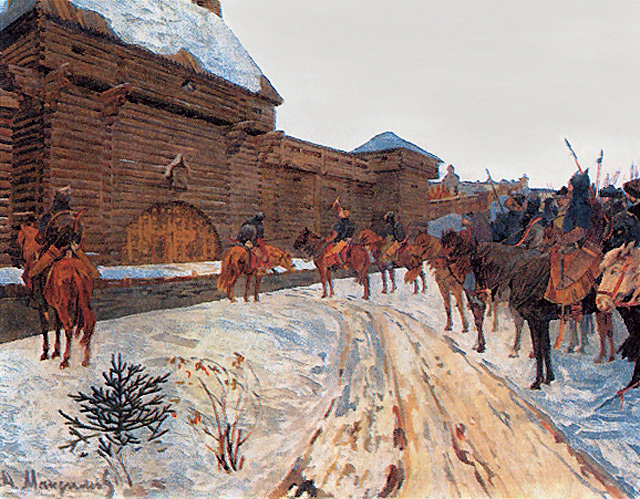
One lesson you will learn if you continue reading is that it is a very bad idea to invade Russia, especially in the winter. Poland tried it in the seventeenth century, Sweden tried it in the eighteenth, France tried it in the nineteenth, and Germany tried it in the twentieth century. All of those invaders got worse than they gave. Only the Mongols pulled it off, because they had the toughest army of the Middle Ages.
The Baltic Crusades Begin
After missionaries converted the Slavs, Vikings and Hungarians to Christianity in the tenth century, the only part of Europe the remained pagan was the northeast corner. This was the homeland of the Balts, Finns and Saami (Lapps), on the eastern shore of the Baltic, and in the part of the taiga and tundra the Russians had not penetrated yet. The Russians sent some Orthodox missionaries to the Balts after they became Christian, but because they did not back up their clergy with armed men, they only converted a fraction of the population, not enough to make a difference. When Western Europeans took an interest in the lands around the Baltic, they were motivated by more than just a desire to convert pagans. Business-minded folks saw a chance to gain control over the Baltic's oldest source of wealth, the amber trade. And after the struggle in the Middle East between Saracen and Crusader started to go badly for the Christian, the popes looked for a place, hopefully not as far away as the Levant, where they could wage a holy war with the odds in their favor; in the twelfth century, northeastern Europe seemed to fit that description.
However, the local climate and logistics meant that any Western European activity would not be easy. Much of this territory was inaccessible; the bogs, lakes and thick virgin forests often meant that people could only travel through the area by following the rivers, the way the Varangians had done. Travelers with horses found that it was easiest to get through the area in the winter, when they could cross rivers and lakes by walking on the ice, the way the Mongols did when they invaded Russia. Missionaries were reluctant to go to a region so remote; this wasn't the place to be if you were interested in anything besides winning souls to Christ. The Saami were too far north and too few in number to justify visiting them at this time. And two of the other tribes, the Livonians among the Finns and the Prussians among the Balts, were fanatically anti-Christian. And the Curonians, the tribe from which the Kurland peninsula gets its name, were anti-everybody; this tribe was so warlike that even the Varangians didn't want to mess with them! Thus, from about 1000 to 1200, a line drawn across the Baltic Sea, from Danzig (modern Gdansk) through Gotland to Stockholm, marked the eastern limit of the part of Europe converted and civilized by the Catholic Church.
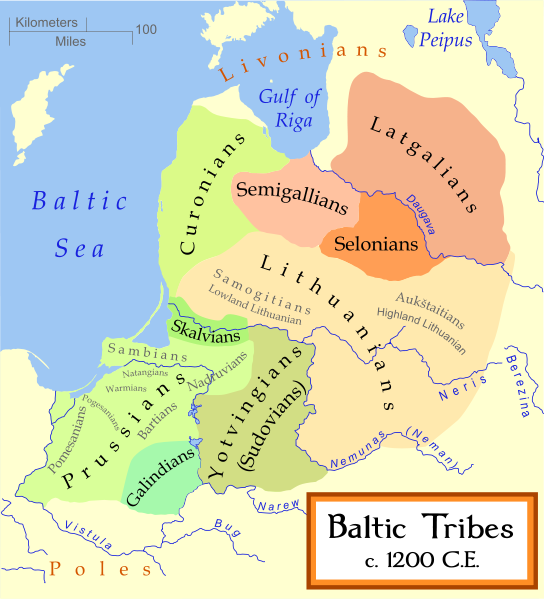
The Balts in 1200. Today their only descendants are the Latvians and Lithuanians (the Estonians are a Finnish tribe), but as you can see, originally they were organized into several tribes. From Wikimedia Commons.
Nevertheless, some missionaries were up to the challenge. One of the first was a German priest, St. Meinhard of Segeberg, who may have gone to Livonia with some merchants as early as 1179. The stone church that Meinhard built in 1184, and a fortress and a castle that went up to defend against pagan attacks, are the oldest stone buildings in the region; the pagans used only wood for their structures. In 1186 he was consecrated as the first bishop of Livonia, a title he held for the last ten years of his life. He managed to win over a few souls by practicing acts of kindness whenever possible, and his successor, a German abbott named Berthold of Hanover, followed the same behavior, but he wasn't as lucky. Once, the Livonian pagans responded to Berthold's gifts and banquets by trying to drown him; another time they burned down a church he was preaching in. After escaping that fire, Berthold fled to the German city of Lübeck, and with the help of an archbishop and some merchants, he recruited a Crusader army to subdue the pagans by force. However, soon after Berthold returned with the Crusaders, he was killed in battle by a Livonian lance.(8) Enraged at the loss of their leader, the Crusaders then went on a rampage, attacking the natives and forcing 150 of them in a two-day period to accept baptism at sword point. But even this wasn't worth the effort; after the Crusaders went back to Germany, the Livonians renounced the Christianity forced upon them, bathed in the Western Dvina River to wash off their baptisms, and chased the remaining priests out of the land.
This was only a temporary pagan victory. The next bishop appointed over the region, Albert of Riga, came in 1200 with twenty-three ships, 500 Crusaders, and an assortment of merchants and peasants (probably 1,000). They captured the native trading post at the mouth of the Western Dvina River, and here the merchants and peasants founded the city of Riga in 1201; this became the base of operations for Germans in the eastern Baltic. One year later, Albert organized the Crusaders into a new military order, the Livonian Brothers of the Sword, to defend Riga and expand the Christian domain in the region. And expand they did; although there were never more than 150 knights in the order, their superior discipline and weapons allowed them to beat their pagan opponents regularly, and as they advanced up the Dvina River, they built stone and brick forts to secure their position. Also, for those Livonians and Latgalians (also called Letts) who accepted baptism, they promised protection against their still-pagan enemies. By 1206, the Latgalians had been converted and after a Livonian rebellion was put down, the Livonians were forcibly baptised again; now attention began to turn to neighboring tribes like the Semigallians and Estonians.
The Livonian bishopric was soon declared a state of the Holy Roman Empire, with Albert as its ruler, but the Crusaders proved to be an undisciplined unit, who tended to forget that they were supposed to be serving the Church. Once, Albert asked some of the knights to put on a Nativity play, to teach that story to a pagan audience, and they inserted some fight scenes so terrifying that most of the audience fled! Later, when the Crusaders were facing tougher than expected resistance in Estonia, Albert called on Denmark's King Waldemar II for help, and Waldemar sent a Danish fleet to save the day for the Crusaders (1219), but then the Crusaders made a deal with the Danes that gave Estonia to Denmark, instead of to Albert. The arrangement only lasted until 1223, when the Estonians revolted against both Germans and Danes. Using captured weapons, they were able to take all the enemy forts, and they slaughtered every German and Danish soldier they got their hands on; they also had the help of Russian soldiers from the cities of Novgorod and Pskov. Reinforcements for the Crusaders arrived, allowing them to regain control in 1224. For a while they tried dividing Estonia between Denmark and the Livonian Brothers of the Sword, but when they started disputing how much each side got, the pope intervened and proclaimed the entire territory (most of modern-day Estonia and Latvia) under his authority, meaning that from 1225 onward, Bishop Albert and the Crusaders owned the whole thing.
The Danish arrival showed that other outsiders had taken an interest in Baltic opportunities. Besides the Germans and the Danes, the Swedes were now expanding into Finland; since the late twelfth century they had been converting and conquering the Suomi (today's Finns). Then another group of Germans, the Knights of the Teutonic Order, entered the game. Founded during the Third Crusade, they started out as an order of German knights, organized very much like the Hospitallers, and based in the Near Eastern city of Acre. Their success encouraged the king of Hungary to grant them a landholding in Transylvania in 1211, to secure Hungary's southeastern border against the Polovtsy. But soon the knights wore out their welcome, by inviting German peasants to work on their tract of land and declaring themselves in service of the pope; these two actions were in effect a declaration of independence. Calling the knights a "fire under the shirt, mouse in the bag, viper in the bosom," the Hungarian king used his own army to drive them out in 1224.
Soon after that door closed on the Teutonic Knights, another one opened. A Polish duke, Conrad of Mazovia, lived next door to the hostile Prussians, who frequently raided Poland, taking captives and selling them into slavery. Conrad had about a dozen knights, whom he called the Knights of Dobrzyn, but they could scarcely even defend their own castle. In 1226 he invited the Teutonic Knights with this offer: if they would defend his realm from the Prussians, they could have the fort of Kulm, and keep any Prussian land they conquered. The Grand Master of the order was reluctant to go for it, because he did not want to repeat what had happened in Hungary, so he waited until both the Holy Roman emperor and the pope approved the deal before accepting it; then in 1230, 20 knights and 200 sergeants (foot soldiers) moved into Kulm.
Although the Prussians fought back bitterly, the knights won their battles, following the Vistula River to its mouth and then advancing east along the Baltic coast. Behind them they built forts, as the Livonian Brothers of the Sword had done, and German peasants came to settle the now-secure land. They did better than the other Crusaders for two reasons. First, they were in effect an independent state, not directly under the authority of anyone else. Second, there were more of them. Their monasteries and castles across Europe did a better job of recruiting new members for the order than the Sword Brothers had done, and to get to Kulm, recruits only had to travel overland across Poland, while going to Riga required a trip by sea. One result was that the Teutonic Knights absorbed the other orders, because the latter had reached their limits. The tiny Knights of Dobrzyn order had already joined them in 1235. The Sword Brothers rose to their level of incompetence (as the Peter Principle puts it) when they invaded Lithuania in 1236. The historian who recorded what happened wrote down that the Crusaders "robbed and burned wonderfully in many bands, and ravaged up and down the land freely," until they reached a place called Saule. We don't know exactly where this battle took place; Saule simply means "sun" in the Balt languages. What we do know is that the Lithuanians ambushed their opponents in a swamp, where their light cavalry had the advantage over the heavy cavalry of the knights. About 50 Crusaders were killed, including the order's Grand Master; 2,700 foot soldiers (mostly tribesmen allied with the Crusaders) were also killed. Those pagans still living in Estonia and Latvia revolted when they heard the news, especially on Saaremaa, an offshore Estonian island. These disasters left the Sword Brothers so demoralized and reduced in number that the remainder of them joined the Teutonic Knights in 1237, meaning that the Teutonic Knights were now the dominant pro-Western faction in the Baltic.
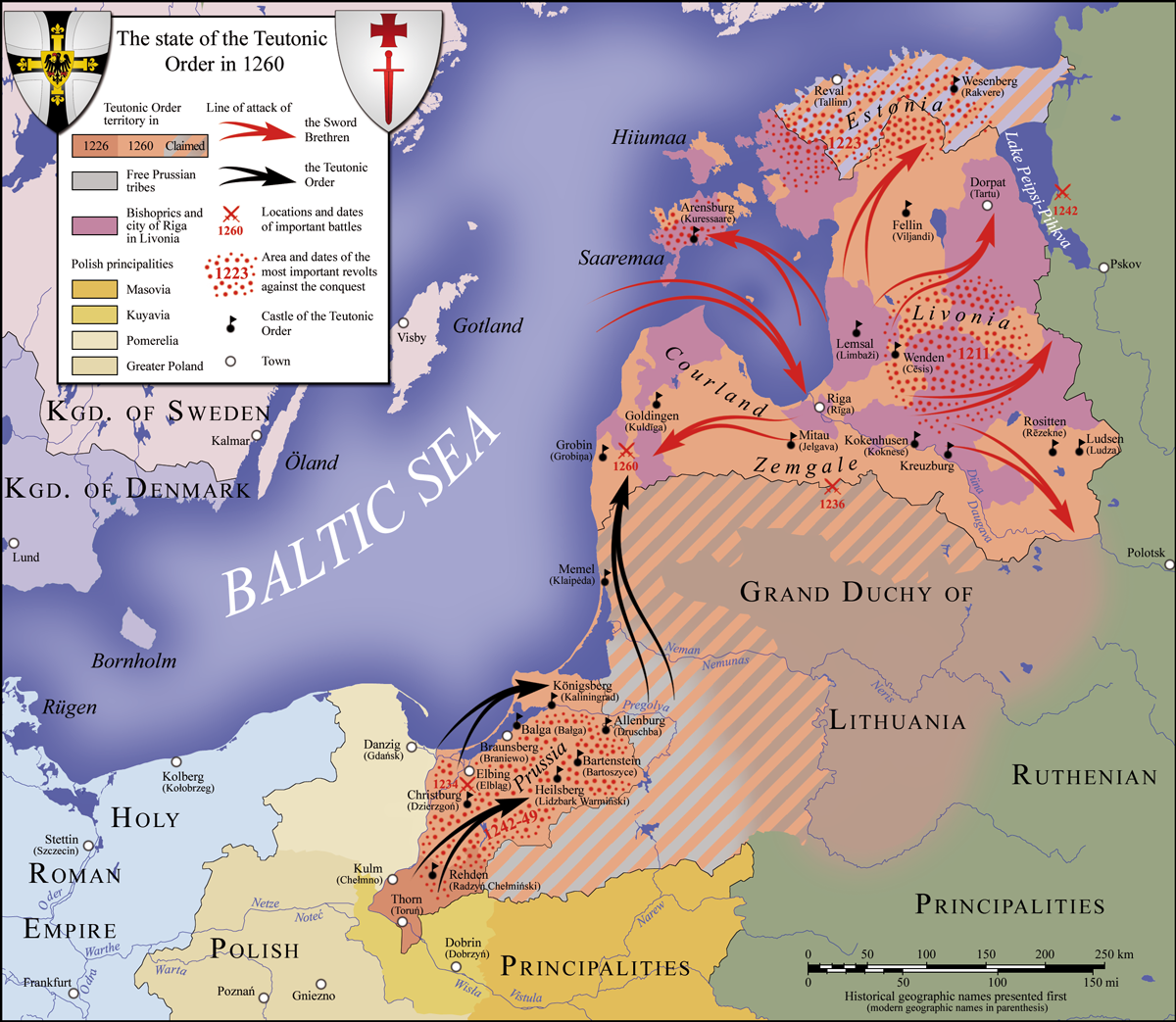
The campaigns of the Livonian Brothers of the Sword (red arrows) and the Knights of the Teutonic Order (black arrows), 1200-1260. This is a thumbnail picture, click on it to see the full-sized map (850 KB, opens in a separate window). From Wikimedia Commons.
Alexander Nevsky
Last but not least, the Russian city of Novgorod got involved in the Baltic region, by gaining control over the Karelians, the Finnish tribe living between the Gulf of Finland and the White Sea. In 1227, Novgorod's Prince Yaroslav II led a successful raid against the Tavastians, a tribe in central Finland. The Tavastians tried to retaliate with an attack of their own upon Novgorod in the following year, only to suffer a devastating defeat, because the Karelians, traditional enemies of the Tavastians, fought on Novgorod's side. However, the pope was alarmed by Novgorod's success, because the Russians were Orthodox Christians; from the Catholic point of view, the Orthodox Church was a heresy, and belonging to it was almost as bad as being a pagan. Thus, in 1229 the pope ordered a trade embargo on Novgorod. The embargo came at the same time as a crop failure caused by early autumn frosts, so thousands of Novgorodians starved to death that year. However, the merchants of the western Baltic, those Germans who would soon found the Hanseatic League, were not willing to give up their profitable trade with Novgorod because the pope said so, and for that reason, the embargo did not last very long.
In 1236, Yaroslav got to become the prince of Kiev, and he handed over rule of Novgorod to his fifteen-year-old son, Alexander. Then in 1240, Novgorod faced the first of three military threats that were more serious than the economic threat had been. It came from the Swedes, who marched an army up the Neva River toward Novgorod, backed by their Suomi and Tavastian allies. The Swedish commander, a noble named Birger Jarl, thought Novgorod wouldn't be a tough opponent, but he was no match for the young Alexander, who charged at the first opportunity and inflicted a crushing defeat. Because of this battle on the banks of the Neva, modern-day Russians call the Novgorod prince Alexander Nevsky.
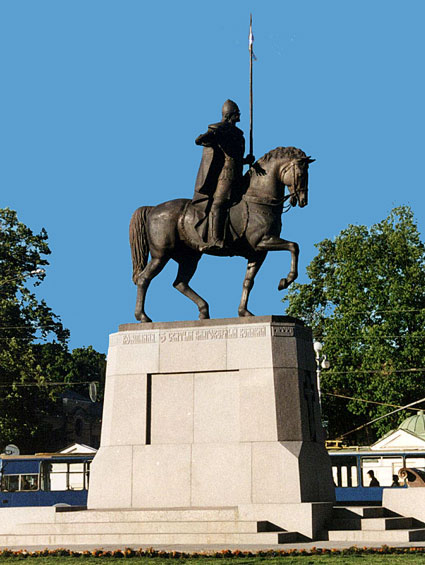
This statue of Alexander Nevsky was erected in 2002, on one end of the avenue named after him in St. Petersburg, Nevsky Prospect. Source: http://www.nevsky-prospekt.com/alexander.html
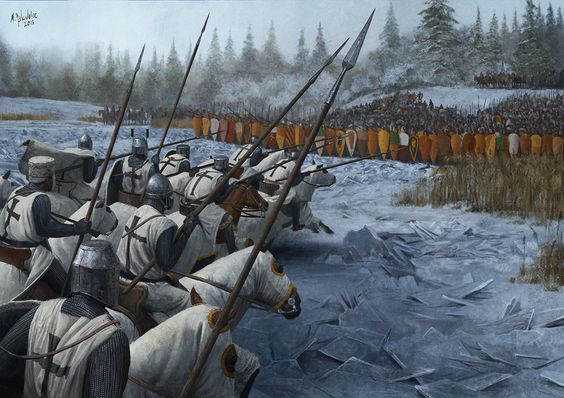
When the Teutonic Knights took over the Livonian Brothers of the Sword and their holdings, King Waldemar of Denmark reminded them of his claim to Estonia. They agreed to a compromise where the Danes got the northern half of Estonia, and the Teutonic Knights got the southern half. When the pope heard about this, he got involved in Baltic affairs again, declaring that he would only approve of this division if the Danes and Germans both went on a Crusade against the Russian heretics. Accordingly, in 1240 a combined German-Danish force took the towns of Izborsk, Pskov and Koporye. Alexander staged a counterattack in 1241 that recovered Pskov, but then the Germans, Danes and their Estonian allies marched on Novgorod itself. Alexander could not defeat the heavily armored knights in a straight slugging match, so on April 5, 1242 he let them charge toward him across the frozen Lake Peipus, and on the other side he hit them with an attack on each flank. Nowadays, in part because of the movie Sergei Eisenstein made about Alexander Nevsky, popular imagination sees the battle ending when the ice on the lake broke and knights sank out of sight. Although we have no medieval documents saying this really happened, the unusual conditions of the battle have given it the name we use, "the Battle on the Ice."
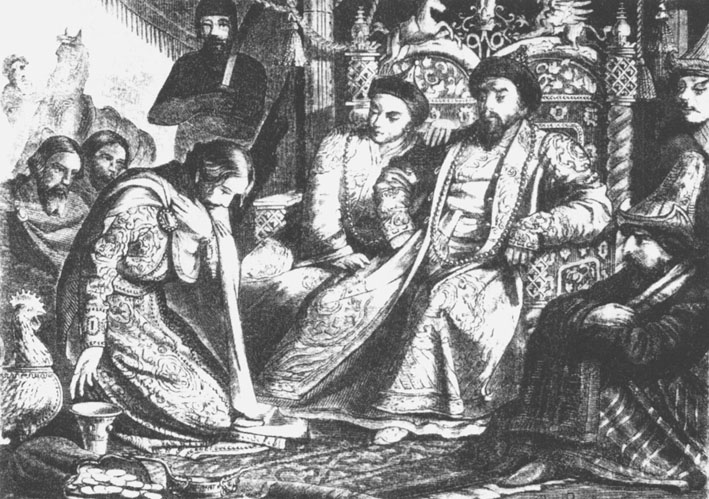
The Mongols were the third threat to Novgorod, because they had wasted the rest of Russia by this time. Alexander chose to pay tribute, instead of fighting them. For that reason, and because the thick forest around the Baltic made it difficult for the Mongol cavalry to get at Novgorod, the Mongols spared the city. Buying off the Mongols may have been the right decision, but it raises questions about Alexander for us. Today he is remembered as the only Russian hero in the country's darkest time, the thirteenth century, so keep in mind that he was also a loyal vassal to the Mongols for the rest of his life. In 1252 Sartaq Khan, Batu's son, rewarded Alexander by appointing him Grand Duke of Vladimir, and a few years later, when the Novgorodians revolted against the census and tribute the Mongols had imposed on them, Alexander used the threat of another Mongol invasion to make them pay the full amount (1259). Finally, in 1262 another anti-tribute insurrection broke out in the city of Suzdal, and showed signs of spreading to the rest of the Russian states. Alexander went to Sarai, the Mongol capital, to plead their case before the Khan; he succeeded in not only getting the Mongols to reduce the tribute, but also persuaded them to stop requiring that Russian states contribute soldiers to fight in the Mongol army. Unfortunately, he had to stay in Sarai for the whole winter of 1262-63 to do this; he fell ill during this time, and died on the way home afterwards. Nearly three hundred years later, the Russian Orthodox Church would canonize him as a saint.
It was left to Alexander's successors to settle the conflicting claims by Sweden and Novgorod over the Finnish tribes. Birger Jarl completed the Swedish conquest of the Tavastians in 1249, and from 1256 onward, Russian chronicles acknowledge that most of Finland was under Swedish rule. Forty years of infrequent but fierce border raids between the two sides followed, and then in 1293 a Swede named Tyrgils Knuttson tried to conquer Karelia as well. He only succeeded on the shore of the Gulf of Finland, where he captured the mouth of the Neva River and built Vyborg Castle nearby. For the next four hundred years, until Peter the Great captured it in 1710, Vyborg would be Sweden's easternmost city. After that came another thirty years of hostilities; in 1318 the Novgorodians burned down Turku, Finland's oldest city. Neither side could win a decisive victory, though, and in 1323 they signed the Treaty of Nöteborg, the first attempt to define the border between them.
This was not the last word on relations between the Russians, Finns and Swedes; more wars involving them would be fought for centuries to come. In that sense, the treaty was really a cease-fire. Still, after this Sweden was no longer considered a participant in the northern Crusades. Finland had never attracted many knights, because this was a land with much hardship, few profits, and no glory. The soldiers who ended up settling in places like Turku and Vyborg were called "Food Swedes" by the Finns, because their voracious appetites were more impressive than their fighting ability.
Meanwhile along Scandinavia's Atlantic coast, the Norse/Norwegians had been steadily expanding northward from Trondheim, their northernmost community at the beginning of the Viking era. By the thirteenth century, they had reached Lapland, where they met expeditions from Novgorod. We know this because in 1251 Novgorod sent an embassy to the king of Norway, complaining about clashes between Norwegians and Karelians in this area. The next three quarters of a century saw the building of forts here, and a series of raids and counter-raids. What makes this amazing is that it all happened above the Arctic Circle; this is probably the northernmost war of all time. It was settled by the Treaty of Novgorod in 1326, which declared Lapland a "march" or buffer zone, and stated who could tax each Saami tribe, but did not draw a border between Norway and Novgorod. Even so, it left the Norwegians in control of the North Cape district (henceforth called Finnmark), while the Novgorodians (and later the Russians) got the Kola peninsula; that arrangement has lasted to this day.
The Golden Horde
Throughout the 1240s and 1250s the Mongol Empire continued to grow, until it was too large to be effectively governed from one place. Thus, under Genghis Khan's grandsons it broke up into four smaller but still formidable states. Batu Khan's family received the portion described previously -- the valley of the Volga, the plains just north of the Caucasus, a piece of Kazakhstan, and western Siberia -- with the Ukraine added. They built a capital city named Sarai near the Volga delta, but because its inhabitants were used to the nomadic life, it was basically a tent city. At an uncertain later date, another capital, New Sarai, was built a few miles upstream, with more real buildings than tents. Sometimes we call this city Sarai Berke, out of the belief that this project was done by Batu's brother Berke. And as noted in an earlier section, Batu's descendants (the so-called "Blue Horde") were the official rulers, but descendants of Batu's brothers Orda and Shiban were the ones really in charge of the lands east of the Urals.
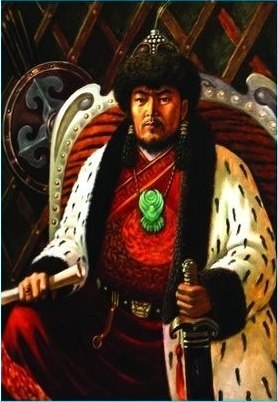
Unlike the Mongols in the Persian and Chinese portions of the empire, the ruling elite refused to adopt the civilization of their subjects, but tried to hold onto both their identity and the customs of the steppe. To give one example, a few Mongols were Christian, but instead of following the Catholic or Orthodox Churches, these Mongols were Nestorians, a Christian denomination that had been based in Asia since the fifth century. Still, it appears that they were outnumbered by the Turkic tribes (Polovtsi, Bulgars, Kyrgyz, Khazars, etc.) living around them, and were absorbed within two generations; e.g., after 1280, the Golden Horde's coins bore Turkish inscriptions instead of Mongolian ones. Europeans didn't bother to distinguish between the different Mongol and Turkic groups living on the steppes, and tended to simply call them all "Tartars."(9)
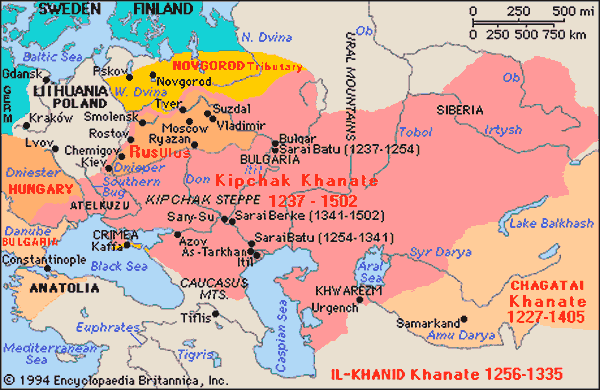
The Mongols chose not to rule the Russians directly, because in the forests of northern and western Europe, the mounted archers of the steppes would find both their speed and the range of their arrows reduced, putting them at a great disadvantage against the natives. Instead, they gathered tribute every year, giving one of the Russian princes a permit called a yarlyk to gather the wealth of Russia for the Khan. If the annual collection of gold and slaves did not meet the Khan's demands, the Mongols would raid the offenders to show they meant business. Any tribute gathered beyond what the Mongols called for went to the holder of the yarlyk, so the Russian princes often fought for the right of holding this "honor." Under this system the Russians learned a lot about tyranny, brutality, and inhumanity in general, and it shows in the types of governments they would establish in the future. Before 1240 the Russians were generally a friendly, trusting people; those traits do not characterize the Russians who have lived since then.(10)
Batu died in 1255. His son Sartaq, a Nestorian Christian, happened to be in Mongolia at the time; the Great Khan approved of him succeeding Batu, but as soon as he got back from this trip he died, too. The Great Khan next appointed a ten-year-old named Ulaghchi. We don't know if Ulaghchi was a son or a brother of Sartaq, and it doesn't matter, for he was just as short-lived. Berke, Batu's brother, took over after this, and his reign of nine years (1257-66) meant he was the first khan after Batu to get anything done.
Berke was a ruler of action. To the west, he let Europeans know the Khanate still meant business by launching a raid into Lithuania, Poland and Prussia (1259-60), which sacked the Polish cities of Sandomierz and Cracow, devastated the Teutonic Knights, and persuaded the king of Hungary to come and pay him homage. Berke also demanded a meeting with the most powerful king in western Europe, Louis IX of France, but both the khan and the king were too busy for such a meeting to ever take place. Then in 1265 he sent a raid into the Balkans to trash Bulgaria and Byzantine Thrace.
However, it was his actions regarding religion that put the Khanate on a new course. Berke was the first Mongol khan to embrace Islam, having converted while on a trip to Central Asia in the 1240s. However, he did not end Genghis Khan's tolerance for all religions, and it took another fifty years for the rest of the ruling family to accept the new faith. One result was that it poisoned relations between him and Hulagu, his cousin who had been assigned the Middle Eastern portion of the Mongol Empire. Berke denounced Hulagu for destroying Baghdad and executing the last Abbasid caliph. At first he held off, resisting the temptation to start a war among family members, but when another war broke out in the east between two brothers of Hulagu, Kublai and Ariq Böke, over who would become the next Great Khan, Berke supported the claim of the latter. Then in 1261 he gave in and started a border war with Hulagu; besides claiming to avenge Islam, he wanted the province of Azerbaijan, part of Hulagu's realm that contained good pasture lands for horses. This conflict in the neighborhood of the Caucasus lasted for the rest of Berke's reign; neither side won a decisive victory, and no territory changed hands. In 1263, he forged an alliance with the Mamelukes, the new dynasty of ex-slaves ruling Egypt, and together the Golden Horde and the Mamelukes stopped further Mongol expansion into the lands south and west of Iraq; that probably saved both Jerusalem and Mecca from the ravages of a Mongol invasion. All the activities mentioned in this paragraph ensured that the breakup of the Mongol empire would be permanent.
Berke was succeeded by a grandson of Batu, called Mengu-Timur in Turkish or Möngke Temür in Mongolian (1266-80). The main event of his reign was participation in a Central Asian civil war between Genghis Khan's grandsons. Also worth remembering is that he showed his toleration of Christianity by exempting the Orthodox Church from the tribute the Russians had to pay, and he stopped putting the image of the current Great Khan, Kublai, on Golden Horde coins -- in effect declaring independence from the rest of the Mongol Empire. And around 1266, he allowed the Italian city-state of Genoa to establish an outpost in the Crimea, Kaffa; this would become an important port for trade between Russia and the Mediterranean.
The next two rulers, Töde Möngke (1280-87) and Töle Buqa (1287-91), were not very competent. During their reigns, real power was held by a nephew of Batu named Nogai. Nogai commanded the warriors in the western part of the realm, and led raids into Lithuania, Poland, and Bulgaria; the latter was done to assist an ally, the Byzantine Empire. Acting as a kingmaker, he deposed Töde Möngke and killed Töle Buqa, but the khan he installed in place of them, Toqta (1291-1312), refused to act as his puppet. Nogai and Toqta acted as rivals, until a civil war broke out between the factions they controlled. Nogai won the first battle, at the Don River, in 1297, but old age caused him to make the mistake of not marching on Sarai after that victory. The second battle, fought near the Dnieper in 1299, went Toqta's way; Nogai's followers deserted him, and he was killed by a Russian serving in Toqta's army. After that, Toqta put down a rebellion in the White Horde to the east, and attacked the port of Kaffa because of some Italian trade practices he did not like. Finally, trivia fans should note that Toqta was a Shamanist (Mongolian pagan) with an interest in Buddhism, meaning he was the last non-Moslem ruler of the Golden Horde.
Muhammad Özbeg, also called Uzbeg or Ozbeg Khan, was a nephew of Toqta. Toqta didn't like him because like Berke, he was a convert to Islam, and had him exiled, but upon Toqta's death Muhammad Özbeg promptly returned and seized power. His reign (1312-41) was the longest of any Golden Horde ruler, and is now considered the time when the Golden Horde reached its peak. It has been said that he transformed the Khanate into a Sultanate, because he encouraged the whole ruling class to convert, but because he was not a fundamentalist (he belonged to a Sufi sect), he continued to tolerate other religions, especially Christianity. In 1327 he put down an anti-Mongol revolt from the Russian city of Tver, executed its ruler, and transferred the yarlyk from Tver to Moscow; that would have a very important effect on Russian history.
After Muhammad Özbeg came his son Tînî Beg, who only ruled for a year, and then another son, Jânî Beg (1342-57). Under Jânî Beg the previous religious tolerance disappeared; the conversion to Islam that Muhammad Özbeg recommended was now ordered. In partnership with Moscow, Jânî Beg led raids on Lithuania and Poland in the 1340s. However, his reign also saw the arrival on the steppe of an enemy the Mongols could not fight, the Black Death. This plague killed both his subjects and his vassals; the loss of many taxpayers is bad news for any nation, and it set the Golden Horde on a rapid, permanent decline. Even worse, the Mongols made another attack on Kaffa while they were infected, allowing the plague to spread to Europe. Below the Caucasus, the breakup of the Mongol state in the Middle East allowed Jânî Beg to capture Azerbaijan in 1355, but the Golden Horder was only strong enough to hold that territory for three years.
Jânî Beg was poisoned, and his son Berdi Beg was in turn assassinated two years later (1359). Berdi Beg's only child was a daughter, who married a general named Mamai. With no heir to the throne, the Khanate fell into anarchy, with as many as four khans competing for the top spot at the same time. Mamai thus became the most powerful man in the realm, leading the army until he was defeated at the battle of Kulikovo Pole in 1380 (see the next chapter). By then, nine official khans, and maybe ten pretenders, had risen and fallen; when the last one was gone, the dynasty of the Blue Horde became extinct. Order and unity were restored when the Blue Horde's former vassals, the White Horde, took over, first under Urus Khan (1372-77), and then under Tokhtamysh (1380-97). Meanwhile, Genoa gained control over the whole southern coast of the Crimea, and Lithuania and the Principality of Moscow grew tremendously. Although these two newcomers were not yet as strong as the Golden Horde, they would challenge the Mongols soon.
This is the End of Chapter 2.
FOOTNOTES
1. The origin of the term Rus is not known. Various theories have been advanced, like the name of the tribe living at Novgorod, a Ukrainian river called Ros, a town in Sweden named Roslagen, the Finnish word for Swedes, Ruotsi, and even Rosh from the Old Testament (Ezekiel 38:2). Modern Swedish and Russian historians disagree on who used the name first.
2. The first Varangian tax collectors behaved as if they were on plundering expeditions; after this Olga set up a formal procedure of revenue assessment and collection, to make the whole business less extortionate.
3. Even then, long before the invention of vodka, getting drunk appears to have the favorite Russian pastime.
4. Boris and Gleb did not want to rule, and when Svyatopolk came for them, they went to their deaths with Christian humility. Because of that they were canonized as the first martyrs of the Russian church in the fifteenth century.
5. Polovtsy is the Slavic name for the tribe. They are known as Cumans by the Greeks, Kipchaks by the Mongols, and Oghuz by the Turks. The name depends on whose history you are reading.
6. The small town of Kozelsk was the hardest to take; it put up a magnificent defense that detained the entire Mongol army for two months in 1238. Determined to resist for as long as possible, the residents of Kozelsk even plugged the breaches made in the walls with the bodies of their comrades. The Mongols won in the end, though, and burned down the city like they had done to so many others.
7. This was a great relief for Europe, though few Europeans at the time knew why the Mongols had left, and attributed it to divine intervention. During the heyday of the Vikings the Church regularly prayed for deliverance from "the fury of the Northmen"; now the same sort of prayers were said to keep the Mongols away.
8. The name of the pagan who slew Berthold was Ymaut or Ymant, depending on the source you're reading. To Latvians he became a national hero, and they continued to honor him even after they became Christian. Imanta, a neighborhood in modern-day Riga, is named after him. My oh my . . .
9. Early in Genghis Khan's career there was a Mongolian tribe called the Tatars, but Europeans who used the name "Tartars" were more likely thinking of Tartarus, the deepest pit of Hell in classical mythology. For them Mongolia was beyond the known world until a few brave travelers went there, of which Marco Polo is the most famous.
10. Of all the Russian states, Galicia was probably in the most pitiful situation. Located in the western Ukraine, it was surrounded by four larger neighbors in the early fourteenth century, and it paid tribute to all of them: the Mongols, Hungary, Lithuania, and Poland.
Support this site!
PAGE NAVIGATOR
A History of Russia
|
Other History Papers |
Beyond History
|
